
Kent County Projected Release Dates
A projected release date is a working sentence-computation date. It starts with the court-imposed term and legally recognized presentence credit. The custodian then applies the correct good-conduct and earned-credit rules, along with later orders and adjustments. An actual release date is the day the custodian executes the release or transfer. Those values can match, but they answer different questions.
Kent County Detention Center holds a mixed population. A pretrial detainee may leave on bond, recognizance, dismissal, or another order, so there is no sentence-based projected date to calculate. A locally sentenced person has a county sentence governed by Maryland’s local detention credit laws. A person committed to the Maryland Department of Public Safety and Correctional Services has a state sentence governed by a different credit framework. A federal detainee passing through the facility belongs to the federal record chain.
A court docket supplies the legal term, credit-for-time-served entries, modifications, and holds shown in the case. It does not establish the hour Kent County Detention Center opened the door. When precise execution matters, pair the court record with the detention center’s release entry or the state institution’s movement record.
Find a Kent County Release Date
No single public portal answers every Kent County release-date question. Start with the court and facility that control the sentence. The public DPSCS locator is useful only to confirm covered current state custody. It expressly removes people who are no longer in custody for any reason and does not publish a projected or tentative date field.
- Identify the custody type. Separate a KCDC pretrial booking, local sentence, Maryland state commitment, federal sentence, and immigration matter before choosing a source.
- Search Maryland Judiciary Case Search for the Kent County case. Read the sentence, start date, presentence credit, concurrent or consecutive terms, modifications, and any probation or warrant entries.
- For a local sentence, contact Kent County Detention Center at 410-778-6025 and ask for the existing sentence or release computation record. Give the case number and booking period.
- For a state sentence, check the DPSCS Incarcerated Individual Locator for current location, then request the existing sentence-computation or release record from DPSCS.
- Ask the custodian whether the date is projected, scheduled, approved, or executed. Preserve the exact field label and the date the record was obtained.
- Confirm the final event with the jail, state institution, or VINE. Follow any detainer or transfer to the receiving agency.
The Kent County released-inmate lookup gives the full custody-type decision path when it is not clear which system last held the person. That distinction must come before date calculation. A closed KCDC booking can mean transfer to DPSCS rather than community release.
Note: A missing DPSCS result proves only that the name was not listed in the covered current-custody locator on the search date.
Kent County State Release Records
The public Maryland locator uses first and last name and returns a current custody location for covered individuals. It is not a released-person archive. Its warning says people no longer in custody due to release, escape, or any other reason are not listed. Some short-sentence individuals may also be absent. Therefore, no result cannot be converted into either a release date or a release claim.
DPSCS uses projected dates inside case management. Its official reentry material says planning occurs within 180 days of the projected date, and a state report distinguishes scheduled releases from accelerated or court-ordered events. Those sources establish that the internal value exists. They do not make it a public locator field. Ask DPSCS for the sentence-computation or release record rather than trying to derive the date from a disappearing search result.
The official DPSCS locator shows the public interface and its custody limitation. This captured image documents the source available to a Kent County searcher.
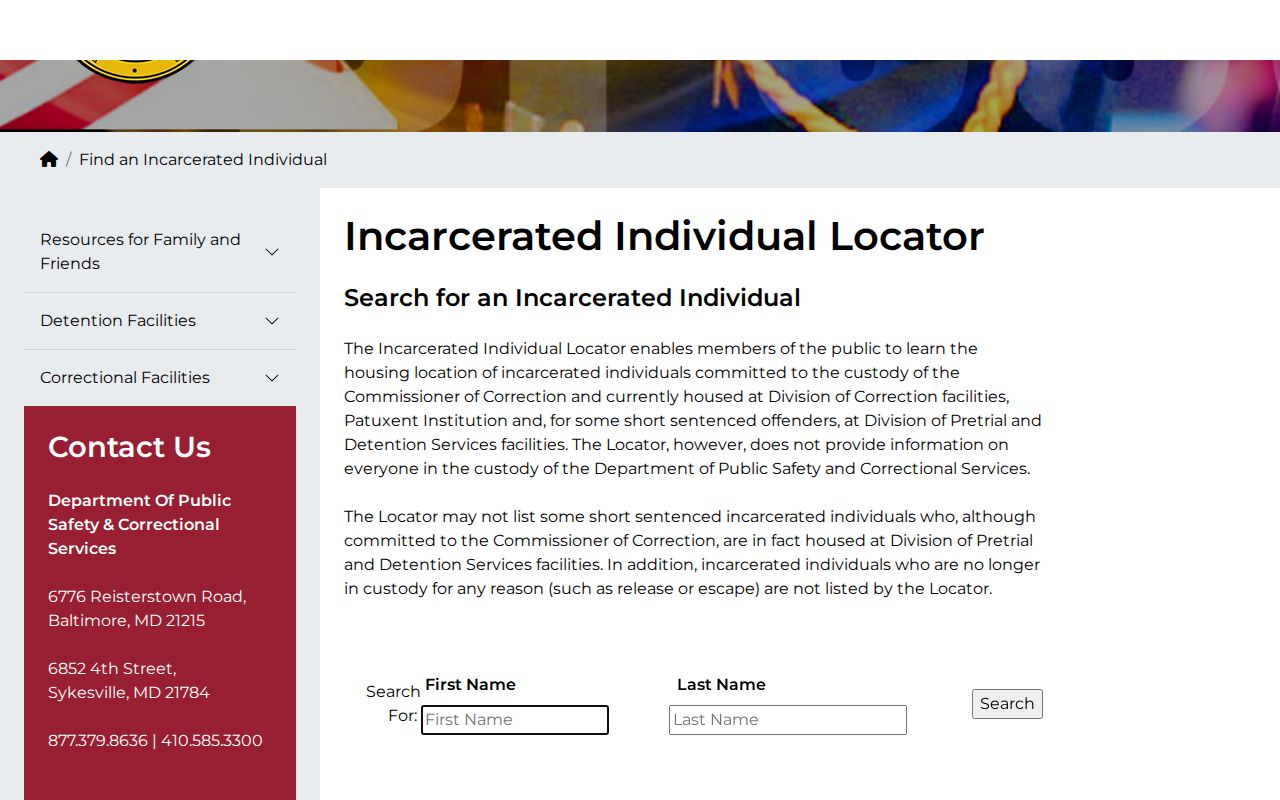
The form can establish current covered state custody, while a direct DPSCS records request is needed for the projected date and computation.
Maryland State Release-Date Credits
For a Maryland state sentence, computation begins with the aggregate court term and presentence credit under Criminal Procedure section 6-218. “Aggregate” means the combined term after concurrent and consecutive rules are applied. DPSCS then accounts for lawful diminution credits. Diminution credits reduce the period of confinement but do not rewrite the court’s original sentence.
Correctional Services section 3-704 permits good-conduct deductions through the term. The general rate is up to ten days per calendar month, while a term that includes specified violent or high-volume drug offenses uses five days per month. Other sections address work tasks, education, and special projects, as well as an aggregate cap. Credits may be revoked or restored under the statutory process.
- Presentence credit
- Time in qualifying custody credited against the sentence by law and the judgment.
- Diminution credit
- A lawful deduction earned under correctional rules, including good conduct and some work or education credits.
- Maximum expiration
- The end of the full sentence term before release mechanisms are considered.
- Mandatory supervision
- Conditional release based on credits before maximum expiration, with continuing legal custody.
Maryland has no blanket rule that every person must serve 85 percent of a sentence. Offense-specific credit rates and parole rules may yield a similar figure in an individual case, but they do not create a statewide shortcut. The judgment, offense, credit ledger, and current DPSCS computation control.
KCDC Release-Date Credit Rules
A sentence served at Kent County Detention Center does not simply inherit the state-prison formula. This is the county-specific computation issue captured by Research Angle O. Maryland maintains a separate local detention credit regime in Title 11, and using the Title 3 DPSCS rate for every KCDC term can produce the wrong date.
Correctional Services section 11-503 addresses a local presentence deduction of five days per calendar month when the statutory discipline and labor conditions are met. It is prorated for a partial month and stops at local sentence, commitment to DPSCS, or release. Section 11-504 addresses postsentence local good conduct. Sections 11-505 and 11-506 cover task and work-project credits, while section 11-507 provides a process for revocation of certain credits.
A sound Kent County calculation therefore needs the actual court judgment, the KCDC admission and sentence dates, recognized time already served, and the local credit ledger. It must also show whether the person was later committed to DPSCS. Once state custody begins, a different custodian and legal framework may control the remaining computation.
| Custody setting | Starting record | Credit framework |
|---|---|---|
| KCDC pretrial | Court docket and custody record | No fixed sentence date until a sentence or release order exists |
| KCDC local sentence | Local judgment and KCDC ledger | Correctional Services sections 11-503 through 11-507 |
| DPSCS state sentence | Judgment and DPSCS sentence computation | Title 3 credit provisions and applicable release laws |
| Federal sentence | Federal judgment and BOP record | Federal computation, not Maryland local credits |
Note: A generic release calculator cannot know whether a Kent County term is local, state, concurrent, consecutive, modified, or subject to a hold.
Why Kent County Release Dates Change
A projected date is a live administrative result, not a promise. It can move after a corrected court entry, a newly posted credit, loss or restoration of earned credit, or a revised interpretation of concurrent and consecutive terms. A date may also cease to answer the main question when another jurisdiction places a valid hold.
| Change | Effect on the date | Record to check |
|---|---|---|
| Presentence credit correction | Moves the computation when credited custody time changes | Court order and custodian computation |
| Earned credit award | May advance a conditional or scheduled release | KCDC or DPSCS credit ledger |
| Disciplinary revocation or restoration | May delay or advance the working date | Correctional decision and updated ledger |
| Court modification | Can change the sentence term or release authority | Kent County docket and signed order |
| Detainer or warrant | May cause transfer or continued custody after one term ends | Originating and receiving agency records |
| Parole decision | Approval, refusal, or prerequisites may affect conditional release timing | Maryland Parole Commission record |
Parole approval is not same-day release. Maryland Parole Commission guidance notes that a home plan, required programming, delayed-release terms, and continued conduct can affect execution. A person may also move from physical confinement to community supervision while remaining in legal custody until the sentence ends.
Request Kent County Release Computations
For a local sentence, ask Kent County Detention Center for an existing computation or release record. Address the request to the detention-center custodian at 104 Vickers Drive, Unit A, Chestertown, MD 21620. The facility lists 410-778-6025. Provide the full name, date of birth if known, booking period, and Kent court case number. Ask for the record that shows the sentence start, credited time, deductions, projected date, and actual release event. KCDC is a county department, so the request does not belong to Sheriff Dennis Hickman’s neighboring office.
For a state sentence, use the DPSCS Public Information Act route. The PIA Coordinator is in the Office of Constituent Services, 6776 Reisterstown Road, Baltimore, MD 21215-2318, and the published email is dpscs.pia@maryland.gov. Specify the person, state identifier if known, institution, time period, and the exact sentence-computation or release record sought. DPSCS does not hold local Kent jail or court files.
Ask the custodian to identify the “as of” date and whether the value is tentative, projected, scheduled, approved, or actual. That wording allows two records obtained on different days to be reconciled. It also prevents an internal planning value from being reported as an executed release.
Confirm Kent County Actual Release
Maryland VINE can send a custody-change alert when the selected record and event are available. Register against the correct person and reporting agency. A VINE event is useful for timing, yet its own update warning means the originating jail or state institution remains the source for a certified release time and reason. The Kent County VINELink check explains the specific-person and notification steps.
If the person left KCDC, ask whether the booking ended in community release, a DPSCS commitment, a federal movement, another county’s warrant, or another transfer. If the person left DPSCS, check the sentence record, VINE, and any Maryland Parole Commission or Division of Parole and Probation record. For BOP custody, use the federal locator rather than Maryland credits. ICE’s locator is a current detention tool and a missing result is not a release record.
The final answer should name both the computation and the event: “The record projected release for one date, and the custodian recorded actual release or transfer on another.” That is more precise than treating every date on a docket, alert, or locator as the same field.