
Kent County Parole and Probation
Maryland splits release decisions from field supervision. The Maryland Parole Commission decides whether an eligible state prisoner is suitable for discretionary parole and handles parole revocation matters. The Maryland Department of Public Safety and Correctional Services, Division of Parole and Probation, supervises people on parole, probation, and mandatory supervision in the community. The court, not the Commission, imposes probation. A person released from Kent County Detention Center on bond may have court conditions but no Division of Parole and Probation case at all.
The first task is to identify the legal basis for the person’s community status. A Kent County court docket may show probation after judgment, a suspended part of a sentence, a violation hearing, or a later discharge. For parole, the Commission record explains the decision while the Division of Parole and Probation handles community reporting. Mandatory supervision is another conditional release route based on sentence credits. It is not the same as the sentence’s maximum expiration.
| Point | Parole | Probation |
|---|---|---|
| Who orders it | Maryland Parole Commission for an eligible state sentence | District or Circuit Court as part of the judgment |
| When it starts | After physical release from state custody and completion of any release prerequisites | As directed by the court, sometimes without a prison term |
| Who supervises | DPSCS Division of Parole and Probation | DPSCS Division of Parole and Probation when supervised probation is ordered |
| Best public starting record | Commission record, VINE event, and DPP confirmation | Kent County court docket and DPP confirmation |
| How it ends | Discharge or full-term expiration under the controlling record | Court-ordered end, successful completion, or discharge shown in the case record |
- Parole
- Conditional community release from a state correctional sentence after a Commission decision.
- Probation
- Court-ordered supervision in place of, or after, some period of confinement.
- Mandatory supervision
- Conditional release before maximum expiration based on lawful sentence credits.
- Discharge
- The formal end of the supervision obligation, not merely release from a building.
Verify Kent County Post-Release Supervision
Maryland does not provide a public name-searchable portal for an assigned agent, reporting office, conditions, active or closed supervision, an absconder flag, or a supervision warrant. The state field-office directory is only an office list. Verification therefore requires several records, each used for its own purpose. A person’s full name, date of birth, Kent court case number, and state identification number can help the agency distinguish similar names.
- Search Maryland Judiciary Case Search and limit results to Kent County. Review both District and Circuit Court cases for the sentence, probation term, later violation entries, and discharge.
- Check Maryland VINE for an available custody or supervision change tied to the correct person and reporting agency. Treat the event as notice, not a full supervision file.
- Call the Chestertown Division of Parole and Probation field office. Ask whether staff can confirm public active-supervision or discharge information, while recognizing that case-file details may be confidential.
- For a parole hearing or decision, contact the Maryland Parole Commission. Its public schedule is not a name-searchable results archive.
- Confirm physical release through the originating jail or correctional record. A court order or parole approval does not supply the actual door time.
The sequence prevents a common mix-up. If Kent County Detention Center closed a booking because the person transferred to Maryland state custody, the event was not release to the community. If DPSCS no longer lists the person, that negative locator result also does not prove release because the public locator excludes all people no longer in covered custody, including people absent for other reasons. The Kent County released-inmate search path explains how to trace the prior custody event before checking supervision.
Note: Record the agency, event label, and search date so that a negative result is not later recast as proof of discharge.
Kent County Supervision Office
Kent County has a local Division of Parole and Probation verification point in Chestertown. The office serves people believed to be reporting locally, but the directory does not prove that a named person has an open case there. Call with enough identifying and court information to help staff find the correct public record. Ask narrowly whether the office can confirm active status, discharge, or the correct office. Do not expect the agent’s notes, risk information, or full case plan to be released.
DPP Chestertown Field Office
Chestertown Business Park
131 North Dixon Drive
Chestertown, MD 21620
410-810-5960
Fax: 410-810-5978
Maryland Parole Commission
6776 Reisterstown Road, Suite 302
Baltimore, MD 21215
410-585-3200 or 877-241-5428
The official DPP office directory shows the local Chestertown entry. The image below preserves that official route as captured for Kent County.
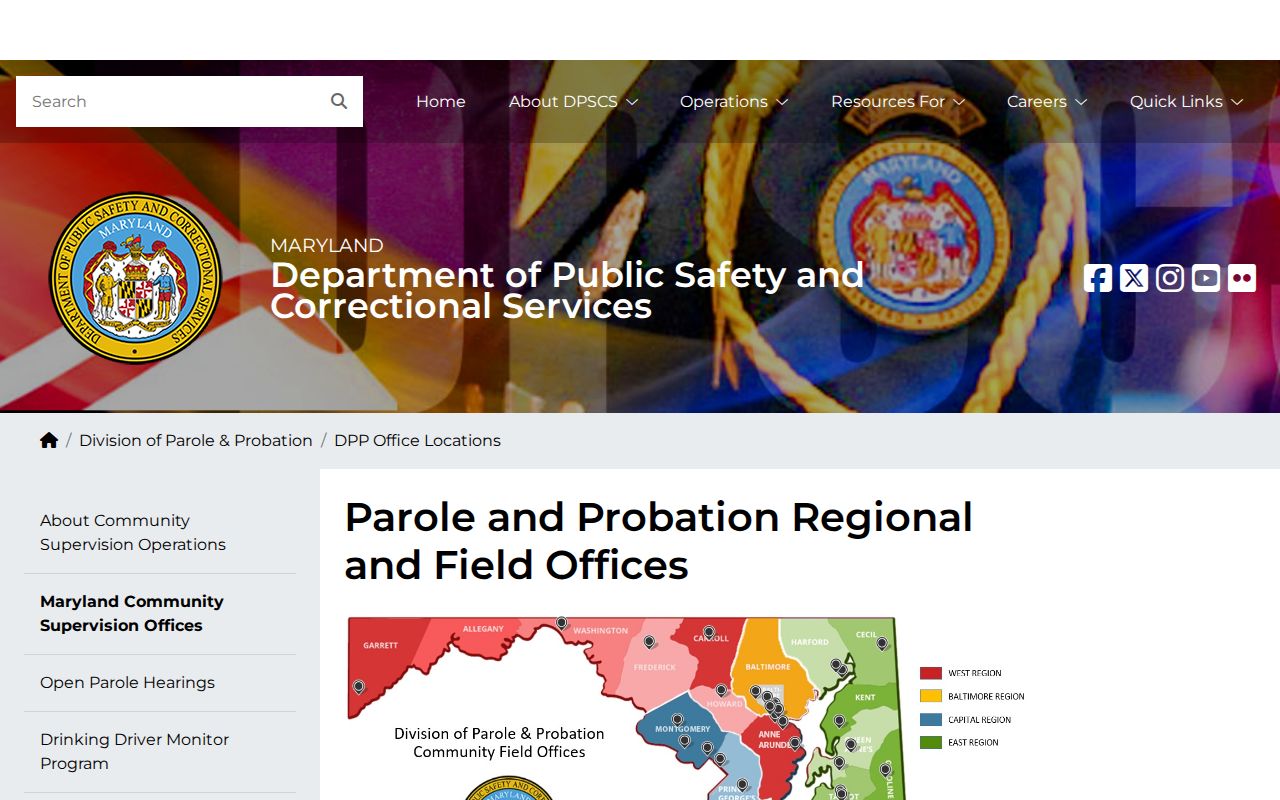
Use the directory for current office contact information, then ask the office what Kent County supervision status can lawfully be confirmed.
Kent County Parole Decision Records
The Maryland Parole Commission publishes a rolling open-hearing schedule, but it does not offer a public name-searchable decision database. The Commission landing page is the durable route to the current schedule and agency contact. The schedule may list a name, state identifier, hearing time, and host facility. It is not proof that parole was granted or that release took place.
Commission guidance identifies three main hearing results: refuse parole, set a rehearing for a later point, or approve parole. Even approval is conditional. A suitable home plan, required programming, delayed-release terms, and continued acceptable conduct can affect execution. Misconduct may suspend an approval. The correct wording is therefore “parole approved” until a custody record or VINE event confirms physical release.
| Hearing schedule | Shows that an open hearing is planned; it does not show the final result. |
|---|---|
| Commission decision | Shows refuse, rehear, or approve and any stated prerequisites. |
| Custody event | Shows whether the approved person actually left the institution or moved elsewhere. |
| DPP record | Addresses supervision after release and the reporting office. |
For a releasable decision or status record, call the Commission at its published numbers. Maryland VINE may also send an event notice to a registered user. Neither channel should be used to guess a release date that has not yet been executed.
Kent County Violations and Absconding
Supervision conditions come from the court, the Commission, and the individual supervision record. A violation can lead to a hearing, a warrant, changed terms, or revocation, depending on the legal basis and facts. A docket entry may show that a violation petition or warrant was filed, but it may not disclose every supervision detail. VINE can provide certain supervision changes when that event is offered for the selected Maryland record.
Maryland law defines absconding more narrowly than a missed report. Under Correctional Services section 6-101, it means willfully evading supervision, and a single missed appointment is expressly excluded. The Division of Parole and Probation has a Warrant Apprehension Unit, yet no official statewide public absconder search was found. Sheriff Dennis Hickman’s Kent County wanted-person page is not a complete DPP absconder list and should not be relabeled as one.
A supervision warrant also does not, by itself, say where someone is held. If the court docket shows a warrant, the next check must match the agency that executed it. KCDC, DPSCS, another county, or a federal custodian may hold the person. Each has a separate custody record.
Note: A parole or probation violation record and a new jail booking are related events, but neither one replaces the other.
Where Kent County Parole Is Verified
The Chestertown field office is the practical local point when a person is believed to report in Kent County. This is the distinctive local layer behind Angle R in the research. Maryland has no public name-searchable supervision portal, so a generic web search cannot replace direct verification. The office can explain whether a public status can be confirmed or route the request to the agency that owns the record.
Physical release can coexist with continuing legal custody. Correctional Services section 7-308 states that a person on parole remains in legal custody until the full undiminished term expires. In plain terms, leaving prison is not the same as reaching the maximum end of the sentence. The person may live in the community while still subject to parole rules and DPP supervision.
This distinction matters when two official systems seem to conflict. A custody locator can stop showing the person because physical confinement ended, while DPP still treats supervision as active. The Commission decision, release record, and DPP status describe different stages rather than competing facts.
Kent County Supervision Notifications
Maryland VINE includes detention centers, state corrections, courts, parole, and probation in its statewide description. Available supervision events can include release, transfer, a supervising-agent change, and violation-hearing results. The exact event choices shown during registration control. The statewide description does not promise that every Kent County event is sent at once.
Use VINELink, the VINELink app, or Maryland VINE by telephone at 1-866-634-8463. TTY access is available at 1-866-847-1298. Open the correct record and compare the person, reporting agency, and status before registering. If the expected event does not appear, contact the Chestertown field office or the source agency instead of treating silence as discharge.
VINE registration is a notice service. It is not the court judgment, the Parole Commission’s decision file, or the Division’s complete supervision record. A notice can point to the next verification step, but the originating agency remains the source for exact status.
Kent County Supervision Discharge
Supervision ends through the authority that created it. A Kent County probation case may show completion, discharge, modification, or a violation outcome in the court docket. Parole and mandatory supervision remain tied to the state sentence and the governing DPSCS record. Reaching the end of one reporting duty should not be described as a full discharge unless the controlling record supports that result.
Request a specific existing record when online sources are unclear. For probation, identify the Kent court case and seek the docket entry or order showing the end of the term. For parole, contact the Commission or DPP and ask for public discharge or maximum-expiration information. For a prior state confinement, DPSCS accepts Public Information Act requests for existing release, discharge, and sentence-computation records.
The cleanest record chain has three parts: the custody record for physical release, the court or Commission record for legal authority, and the DPP record for community supervision. Keeping those roles separate gives a more accurate answer than relying on the current-custody locator or a single alert.