
Understanding Kent County Releases
Kent County Detention Center is the county's only identified active adult detention facility. It is a county government department, not a Maryland state prison. Its mixed population includes local pretrial detainees, locally sentenced people, federal detainees, and adults in work-release programs. For that reason, the end of a KCDC booking can mean freedom in the community, continued control outside the building, or a transfer to another custodian. The word “released” should be used only when an affirmative record supports it.
A Kent County release record answers when and why the detention center ended or changed a specific booking. It does not replace the court docket, which supplies the legal order behind the event. Maryland VINE may give a fast custody-status alert. A receiving agency's locator can show that custody continued elsewhere. Reading those sources together prevents a transfer, writ, or detainer pickup from being mistaken for community release.
Kent County Release Types
The closing reason controls the next search. Bond, recognizance, and a court-ordered release often return a pretrial detainee to the community while the case continues. Time served or sentence expiration can end a local term. Probation may follow a sentence or be imposed without a prison release. Parole and mandatory supervision end physical confinement but keep a person under correctional authority. Transfers and agency pickups end the KCDC location without ending custody.
| Closing event | What it means | Next place to check |
|---|---|---|
| Bond or recognizance | Release on terms while the case remains open | KCDC record and Kent court docket |
| Time served or sentence expiration | A local sentence ended after lawful credit | KCDC release entry and sentencing docket |
| Probation | Court supervision in the community | Case Search and the Chestertown DPP office |
| Parole or mandatory supervision | Physical release before the full term expires | VINE, MPC, and DPP |
| Transfer or detainer pickup | Another agency assumed custody | DPSCS, BOP, ICE, or the named receiving agency |
- Discharge
- The end of a custody or supervision obligation, as recorded by the responsible agency.
- Time served
- A sentence satisfied by time already spent in custody, subject to any other hold.
- Detainer
- A request or legal basis for another authority to take or continue custody.
- Parole
- Conditional release from confinement before the full term ends.
Note: The release code, court order, and receiving-agency record should agree before a KCDC departure is described as community release.
Kent County Release Record Fields
Kent County does not publish a public historical release table or a complete online field schema. A focused request should name the existing booking-and-release record and specify the fields needed. Exact labels and release codes belong to KCDC. An unfamiliar code should not be translated without confirmation from the custodian.
| Requested field | What it can establish |
|---|---|
| Legal name, alias, and date of birth | Distinguishes the correct booking from a person with a similar name |
| Booking or admission number | Links the release event to one confinement episode |
| Admission date and time | Marks when the jail episode began |
| Charge and case number | Connects the jail record with the court file |
| Release date and time | Reports when KCDC processed the closing event |
| Release type and authority | Identifies the jail's reason and the order behind it |
| Destination or receiving agency | May separate community release from transfer, when disclosable |
| Booking photograph | Identifies the intake image, subject to disclosure limits |
Event times can differ across systems. A court may enter an order before the jail completes identity, hold, property, and paperwork checks. Case Search reflects the clerk's record, while VINE reflects an agency-fed update. For an exact door time, the KCDC entry is the best operational source.
Request Kent County Release Records
Address the request to the detention-center custodian or Warden. The county's Citizen's Request Center includes “Detention Center” as a routing choice, but it is not expressly labeled as an MPIA portal. State that the submission is a request under Maryland's Public Information Act when statutory processing is sought. Ask for an existing record, not an answer to “was this person released?”
- Give the full name, date of birth if known, approximate booking date, and court case or booking number.
- Request the admission and release dates, release type, authority, destination, and other named fields.
- Ask for electronic delivery and reasonably segregable public fields if another part is withheld.
- Request a cost estimate before fees exceed a limit chosen by the requester.
- Ask the custodian to identify the legal basis for any denial.
Attention: Custodian/Warden
104 Vickers Drive, Unit A
Chestertown, MD 21620
410-778-6025
Fax: 410-778-7402
The Sheriff's public-information page lists a $5 fee for certain police reports. That amount does not set the cost of a KCDC release record or booking image. Ask the detention center for its estimate. Juvenile, medical, victim, security, investigatory, and expunged material may be withheld while other fields are released.
Note: A narrow request for existing fields is more precise than asking KCDC to research or explain an entire custody history.
Maryland Rules for Kent Releases
Maryland's Public Information Act is in General Provisions Title 4. Its public-record definition includes photographs, and Section 4-205 addresses copies and eligible electronic formats. Those provisions do not make every part of a jail or corrections file public. Other law can protect a field, and the custodian must review the actual record.
Expungement removes qualifying information from court and law-enforcement records. Shielding limits public view for qualifying records. Maryland Courts also restricts remote display of some favorable outcomes. No official KCDC online retention period exists because the county offers no public historical release archive. The Maryland Courts expungement resource and the originating agency are the sound paths for a qualifying record.
Kent Release Records at Court
Kent County's District and Circuit Courts share 103 North Cross Street in Chestertown. The online Maryland Judiciary Case Search covers Kent criminal data beginning May 8, 2000. It can show a case number, charges, disposition, bond entries, sentence, credit for time served, probation, warrants, and later modifications. It supplies the legal context, not the hour KCDC carried out an order.
Some expunged, shielded, sealed, and juvenile records are not public. Certain charges ending in dismissal, acquittal, or nolle prosequi can disappear from remote access while a public courthouse record may still exist. Search both court levels, then ask the clerk for the public file if the summary is incomplete. A blank online result is not proof that there was no custody episode.
The official Kent court directory gives courthouse contact details. Pair any docket finding with the detention-center release entry when exact execution matters.
Kent Alternative Release Programs
Kent County's local statute expressly authorizes community service, home detention, pretrial release, and work release at KCDC. The current county staff listing also names a Home Detention, Pre-Trial and Transportation Unit. A participant can be outside the secure building while still subject to program control or legal custody. Physical absence is not the same as an unconditional discharge.
Check both the program status and the court authority. Correctional Services Section 11-716 supplies the county authority. The KCDC record should identify the booking or program event, while the docket can show the order and any conditions.
Note: Time outside KCDC through an authorized program does not by itself mean the sentence or supervision term has ended.
Kent Release Population Context
KCDC is a small local operation, but population counts cannot be turned into a release list. The cited FY2023 quarterly average daily population ranged from 37 to 43. Reported operating capacity was 81, the quarterly peak was 60, and no days exceeded capacity. Those figures describe occupied beds, not annual bookings or the number of Kent County released inmates.
Direct contact and a focused record request remain the appropriate local methods. A statewide commercial count could refer to a different Kent County or mix arrests with releases.
Find Kent County Released Inmates
Start with the agency that last held the person. Kent County publishes no official jail roster, 24-hour list, 72-hour list, or historical release search. A named-person check therefore begins with VINE and KCDC. Court records show the legal reason, while a written KCDC request supplies the operational release entry. If another agency took custody, follow that receiving system.
- Search Maryland VINE by exact name or identifier and note the reporting agency, status wording, and update time.
- Call KCDC and ask whether the booking ended in community release or transfer.
- Search Kent District and Circuit Court cases for bond, disposition, sentence, probation, or commitment entries.
- Check the DPSCS current locator only when a Maryland state commitment or transfer is possible.
- Use BOP or ICE for the matching federal or immigration custody path.
- Request the existing KCDC release record when the exact time, type, authority, or destination matters.
The separate Kent County 24-Hour Release List page explains the no-feed fallback for same-day inquiries. It does not substitute a made-up report for an official county record.
Kent Release Search Through DPSCS
The DPSCS Incarcerated Individual Locator covers people currently housed in specified Maryland state correctional and pretrial facilities. Its own warning says people no longer in custody for any reason, including release or escape, are not listed. Some short-sentence people may also be absent. It is a current-custody locator, not a Kent County jail archive or a released-person database.
| Public field or result | How to read it |
|---|---|
| First name | Use the full legal spelling when known |
| Last name | Compare matching results with care |
| Housing location | A returned record supports covered current state custody |
| No result | Only proves the name was not listed at that search time |
| Release or projected date | Not exposed as a public field in this locator |
The official interface and its custody limit are visible on the DPSCS locator page.
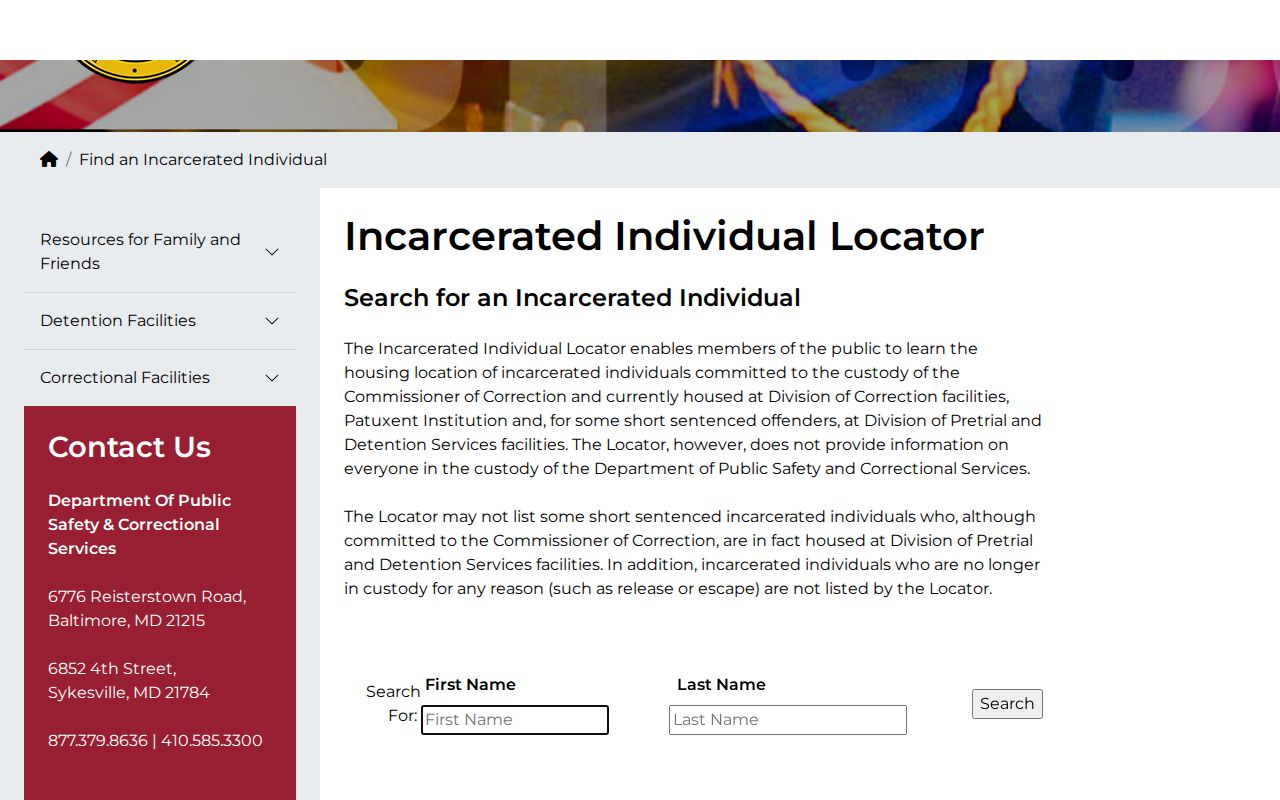
The screenshot reinforces the core distinction: a returned state record supports custody, while a missing record requires VINE, court, supervision, or a records request before release is claimed.
Kent County Recent Release Checks
No official Kent County web roster or recent-release archive was found. The detention-center page gives facility contacts and services, while Sheriff Dennis Hickman's public-information page supplies police-record channels. Neither offers a 24-hour or 72-hour jail release feed. No update cadence, public fields, booking-photo feed, or post-release retention window can be claimed.
For a recent event, search VINE, call KCDC, review the Kent court case, and request an existing jail record. Maryland's PIA does not require KCDC to create a new interval list if none exists. Sheriff news and social channels may preserve an arrest item, but selective incident coverage does not confirm a release.
Note: Kent County, Maryland results must not be replaced with similarly named feeds from Michigan, Delaware, or commercial roster sites.
Kent Release Supervision Checks
Maryland separates parole decisions from field supervision. The Maryland Parole Commission decides discretionary release and handles revocation matters. The Division of Parole and Probation supervises parole, probation, and mandatory-supervision cases. A person released on bond may have no DPP case, while probation can arise directly from a court sentence.
Maryland provides no public name-search for an assigned agent, active status, discharge, conditions, or an absconder flag. Review the court docket, use available VINE notifications, and contact the Chestertown field office. A missed appointment alone is not the legal definition of absconding.
Kent Release Alerts and Transfers
Maryland VINE combines information from detention centers, state corrections, courts, parole, and probation. Search a specific person, compare the reporting agency, and read the status as displayed. Registered users can request offered custody-change notifications. VINE is fast, but its updates can lag and it does not replace the originating jail's certified record.
Automated VINE registration is separate from the Division of Correction's formal written victim-notification program. Enrollment in one does not enroll a person in the other. Choose the needed route, confirm which events are offered during registration, and keep the source agency's contact information for direct verification.
A federal path needs different tools. The BOP locator can show many former federal prisoners with a release date and a status such as Released or Not in BOP Custody. That proves the end of BOP custody, not the absence of another authority. ICE's locator is mainly for current immigration detention, and a missing result is inconclusive. A U.S. Marshals detainee who leaves KCDC may have transferred, entered BOP custody, or been released by a federal court.
Kent Released Versus In Custody
Each tool answers a different custody question. A current locator can rule a person into covered custody, but usually cannot preserve a full history after release. The comparison prevents one system's silence from being treated as another system's proof.
| Source | Best use | Important limit |
|---|---|---|
| KCDC release record | Exact local booking close, time, type, and authority | Must be requested because no public feed exists |
| Maryland VINE | Recent agency-fed status and alerts | Can lag and has no promised public retention period |
| Maryland Case Search | Court order, bond, disposition, sentence, and probation | Does not prove the jail's execution time |
| DPSCS locator | Covered current Maryland correctional custody | Omits people no longer in custody |
| BOP locator | Federal custody and many released federal records | Does not cover KCDC or Maryland DPSCS |
| ICE ODLS | Current immigration detention lookup | A miss does not prove release |
Note: Record the search date and exact status wording because public locators, court displays, and agency feeds can change later.
Kent County Release Facility
Kent County Detention Center is the county's only identified active adult detention facility. It holds a mixed local and federal population and operates alternative programs. Someone leaving KCDC may enter the community, remain under a court program, or transfer into state, federal, immigration, or another local authority. Confirm the closing event with KCDC, VINE, the court docket, and any receiving agency.
The facility is separate from the Sheriff's Office even though both are in the public-safety complex. The historical J. DeWeese Carter Center is not part of the adult facility map, and juvenile custody records must not be folded into an adult released-inmate search.
Getting Home After Kent Release
KCDC does not publish release hours, a family waiting point, an exit door, weekend instructions, or property-return steps. Administrative office hours are not release-processing hours. Call the detention center before traveling and ask what public logistics can be confirmed for the expected event.
Delmarva Community Transit serves Kent County, and the Kent dispatcher can discuss routes at 410-778-5187. General service runs roughly 5:05 a.m. to 5:30 p.m. and requires exact fare. No official source promises a KCDC stop or a release ride. Ask specifically about Vickers Drive and the anticipated time before relying on transit.
Kent Detention Release History
The local jail was authorized for rebuild and expansion in 1985 and was renamed the Detention Center in 1996. Alternative programs, including work release, community service, and home detention, date from that period. A 2024 standards audit confirms the modern facility's mixed pretrial, federal, sentenced, and work-release role.
That history helps explain why KCDC records need careful reading. “Left the building” can describe a release, a program movement, or a transfer. The Maryland State Archives public-safety history supplies the local timeline, while the current detention center remains the source for an individual event.
For the official web channel, the Kent County Sheriff's Office home page is a public local starting point, though it does not host a release feed.

The image shows the official local source that should be preferred over commercial pages when a Kent County release cannot be verified online.
Note: Historical context explains KCDC's roles, but only the current custodian record can establish one person's actual release event.