
Kent County 72-Hour Release Options
The official-source review found no rolling 72-hour release list for Kent County Detention Center. The county has not published a web roster, booking log, archive, update cadence, retention window, or field specification for such a feed. The office of Sheriff Dennis Hickman also does not publish a verified detention-center release feed. A three-day search result from a commercial site cannot be treated as Kent County government data, and a current-custody list from another jurisdiction cannot be relabeled as a local release archive.
A real three-day review begins with the Kent County Detention Center. The center is the only identified active adult detention facility in Kent County, and its administrative contact is 410-778-6025. Ask about a named booking or a clearly defined date interval. If the office confirms that an episode closed, ask whether the result was release into the community, commitment to Maryland DPSCS, movement by the U.S. Marshals, or another transfer.
The Kent County Sheriff public-information page documents official web and records channels, but not a 72-hour jail-release report.
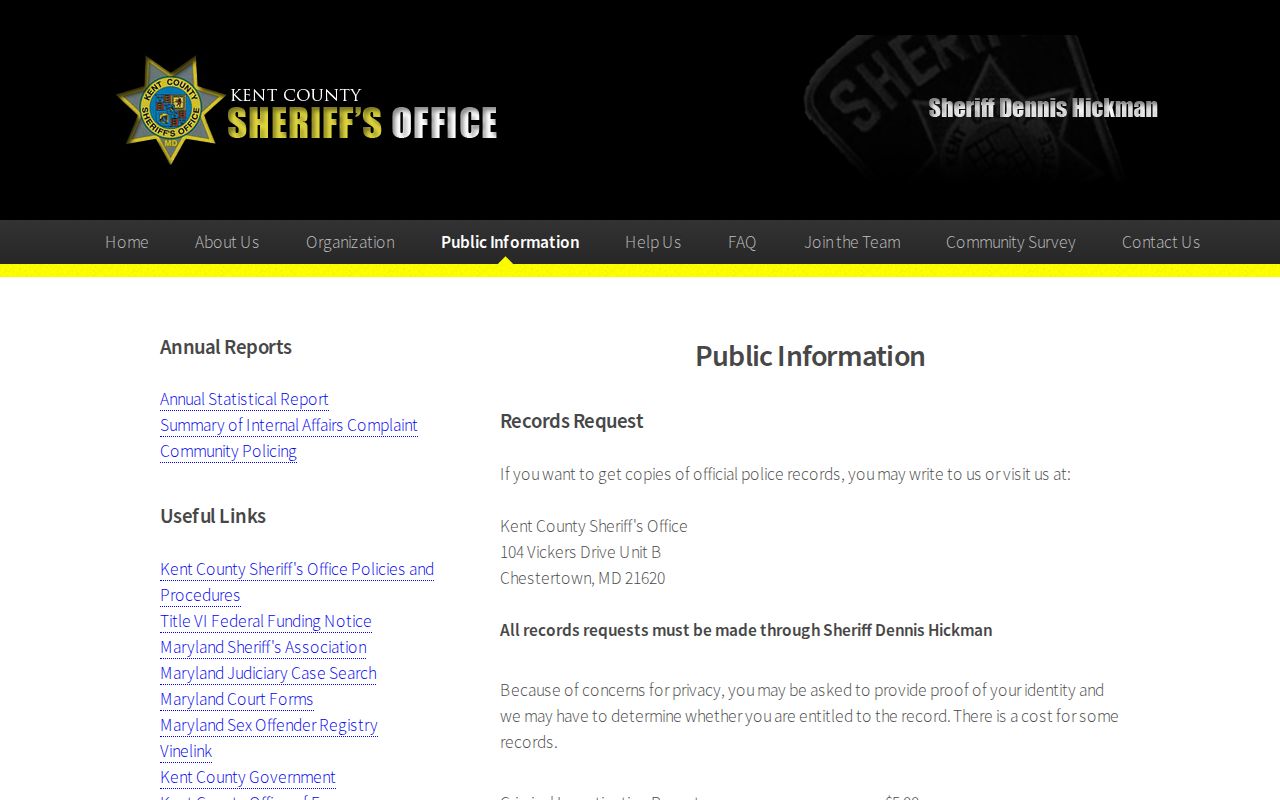
This county source helps separate available police information from the detention center record needed to verify a release.
Review Kent County 72-Hour Releases
The wider period works best as a reconciliation exercise. Search each possible name in VINE, compare court events across the full interval, and ask KCDC for a booking-specific confirmation. When the question concerns every release during the period, ask whether an existing release log is maintained. Maryland’s Public Information Act can reach an existing record, but it does not require an agency to create a new report.
- Define the start and end of the three-day interval, including dates and local time. Keep the range precise.
- Search Maryland VINE for each named person. Record the reporting agency, exact status words, and update time.
- Call Kent County Detention Center at 410-778-6025 with the full name, date of birth if known, booking timeframe, and court case number.
- Review Maryland Judiciary Case Search for bond, dismissal, sentence, credit, warrant, modification, or other legal action in Kent District and Circuit matters.
- Submit a focused MPIA request for the existing release record or an existing log for the date interval. Ask for segregable public fields if some data is withheld.
- Follow any transfer through DPSCS, BOP, or ICE based on the destination reported by KCDC.
The Kent County 24-Hour Release List page narrows the same official-source method to today or the prior day. Use the three-day range when the question spans more than one business day.
Note: Save the search date and source because VINE and court entries may update after the custody event or after clerk processing.
Kent County Three-Day Release Fields
No official 72-hour display exists, so the county has not published a table of public columns. The field inventory below is a request checklist drawn from Kent County’s release-record research. It does not claim that KCDC keeps one public spreadsheet in this form. Each item should be requested as an existing field for the named booking or defined period.
| Field to request | Why it matters across 72 hours |
|---|---|
| Full legal name and alias | Separates people with similar names and preserves the jail’s recorded identity. |
| Booking or admission number | Links each release event to one custody episode. |
| Admission date and time | Provides context for a stay that began before the three-day range. |
| Release date and time | Places the KCDC processing event within the requested window. |
| Release authority or order | Connects the event to a court or other legal source. |
| Release type or reason | Distinguishes bond, time served, court order, transfer, and other codes. |
| Destination or receiving agency | Shows possible continued custody when that information is recorded and releasable. |
Ask KCDC to identify the meaning of any local code. “Release” can describe the end of one custodian’s episode without proving unrestricted community presence. A transfer, writ, detainer pickup, federal movement, or state commitment can all remove a person from KCDC while custody continues.
Kent County Weekend Release Review
A 72-hour range is useful around weekends because it keeps several calendar days in view. Yet Kent County publishes no weekend or holiday release-processing schedule. KCDC’s weekday administrative office hours are not release hours. Court action may occur before identity, detainer, property, transport, and paperwork checks are complete, so the court entry and jail timestamp may fall at different points in the period.
Build a timeline instead of assuming a rolling feed caught everything. Note when the court acted, when KCDC processed the event, when VINE reported the status, and whether another agency received the person. If Friday’s docket shows release but Monday’s call identifies a hold or transfer, the court action did not by itself prove a community exit.
A family planning pickup should call KCDC before traveling. The county does not publish a waiting point, physical release door, weekend policy, or property-return process. Delmarva Community Transit serves Kent County generally, but no source promises a KCDC stop or a ride matched to an evening, weekend, or holiday release.
No Kent County Release Archive
Kent County’s missing roster and recent-release archive is a distinctive local fact, not a gap to fill with a scraped list. It means no supported claim can be made about what a county 72-hour page displays, when it refreshes, or how long a released name remains visible. The official fallback is KCDC phone contact plus a focused jail-record request, triangulated with VINE and Maryland Case Search.
The request should name the record. For one person, ask for the existing booking-and-release record and specify the desired admission time, release time, authority, type, destination, and case number. For an interval, ask whether an existing release log is maintained for the exact dates. Electronic delivery and a fee estimate may be requested, but the Sheriff’s published police-report fee does not establish the price of a KCDC release record.
Maryland public-record exceptions can protect juvenile, medical, victim, security, investigatory, and expunged information. Asking the custodian to provide reasonably segregable public fields lets the office withhold a protected part without treating every nonexempt release fact as unavailable.
Kent County also provides a Citizen’s Request Center with “Detention Center” as a routing option. The portal is not expressly labeled as a dedicated MPIA form. A message sent there should state that it is a request under Maryland’s Public Information Act, identify the exact date interval or booking, and ask the custodian to acknowledge receipt. KCDC records correspondence uses 104 Vickers Drive, Unit A, Chestertown, MD 21620.
Note: No supported Kent County release-feed retention period exists, so a blank web search cannot establish that an older release never occurred.
Kent County Release Sources by Role
A three-day review is strongest when each source stays in its proper lane. The jail answers what KCDC did. The court explains the order or sentence. VINE reports an agency-fed status change. State and federal locators show custody within their own systems, subject to their limits.
| Source | Useful finding | Key limit |
|---|---|---|
| KCDC record | Operational release time, type, authority, and possible destination | Public disclosure may omit protected fields |
| Maryland VINE | Reported custody change and notifications for a matched record | Agency data can lag and retention is not promised |
| Kent court docket | Bond, disposition, sentence, credit, warrant, or release order context | Does not prove the hour KCDC executed the action |
| DPSCS locator | Rules in covered current Maryland state custody | Expressly excludes people no longer in custody |
| BOP or ICE | Federal BOP history or current immigration detention | Neither is a Kent County release archive |
A Maryland Department of Public Safety and Correctional Services locator miss cannot distinguish release from escape, an excluded placement, a spelling mismatch, or a county-only jail stay. Likewise, an ICE miss does not prove community release. The originating custodian’s affirmative movement record controls the local event. If KCDC documents a state commitment, the DPSCS current institution can confirm that county custody ended through transfer rather than community release.
Note: A current-custody result rules in that system’s custody, while a missing result needs an affirmative release or transfer record.
Correcting Kent County Release Information
When a three-day timeline conflicts, preserve the URL, screenshot, search time, disputed field, and supporting record. Send a KCDC timestamp or release-code issue to the detention center. Send a docket error to the appropriate Kent clerk. A VINE issue should go to both the service and the reporting agency because VINE republishes agency-fed events. For a person whose custody path is unclear, use the full Kent County released-inmate lookup to test each possible system.
Correction and expungement are different. Correction fixes wrong source data. Expungement removes qualifying information from public inspection under legal authority, while shielding limits public view under a different process. Maryland Case Search can also omit some favorable outcomes from remote display even when a courthouse record remains open to inspection. A missing online case therefore does not erase the need to verify KCDC’s own event.